
๐Ÿด๓ ง๓ ข๓ ฅ๓ ฎ๓ ง๓ ฟ๐Ÿ‡ฌ๐Ÿ‡ง 2+2=4

https://commontruth.substack.com

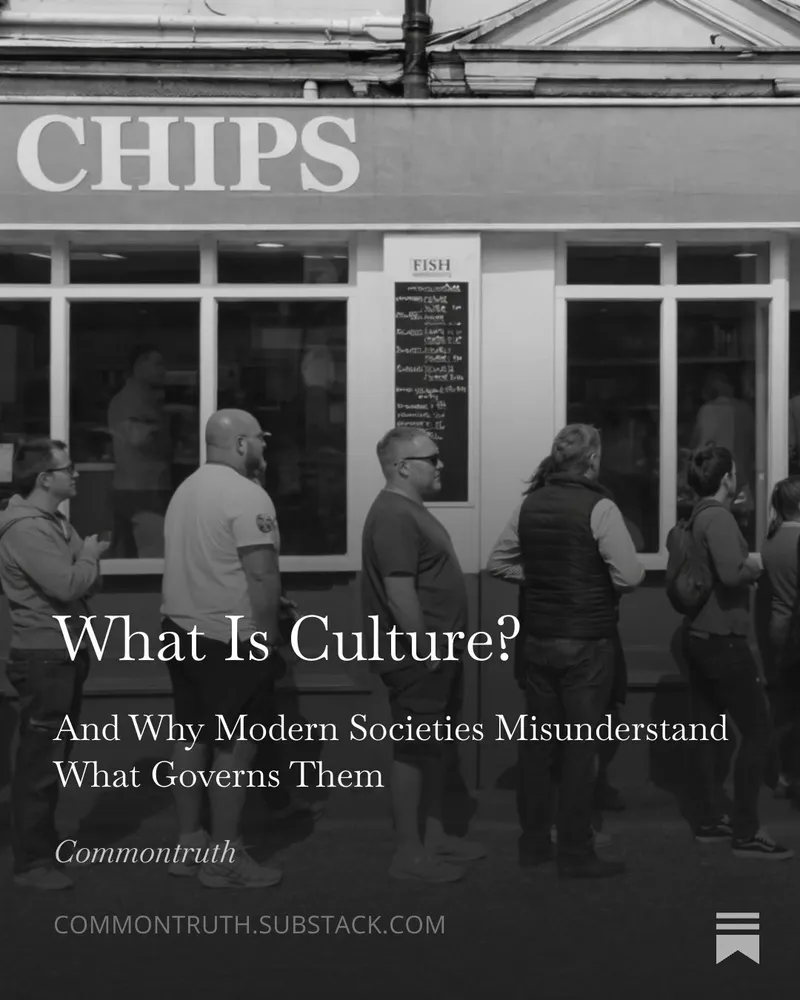
โ€œCultureโ€ is one of the most abused words in modern politics.

Used constantly.
Understood rarely.

This confusion has real consequences.
1
0
1
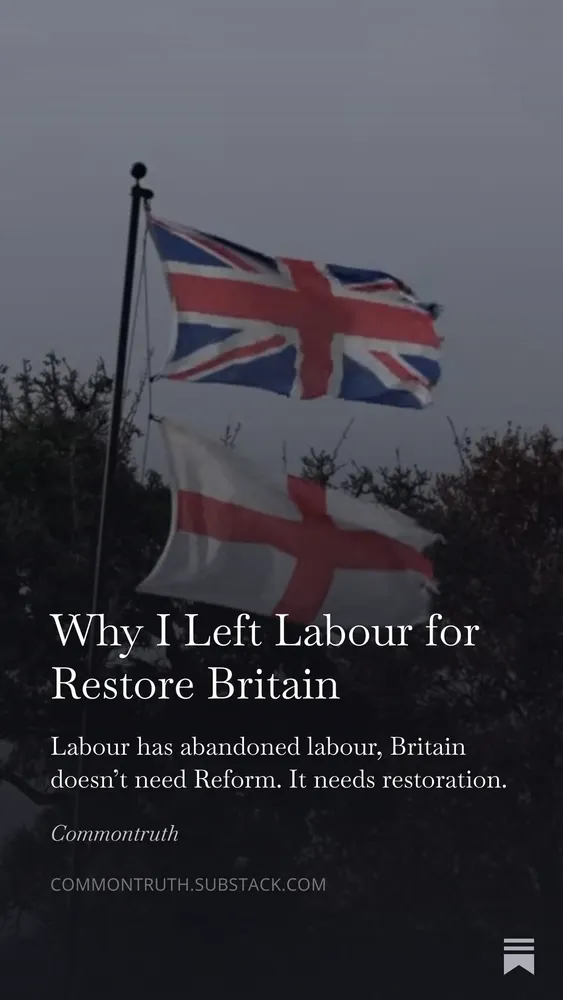
This may seem a strange and concerning transformation. The easy explanation could be that I have been misled by misinformation, radicalised by Russian propaganda, or perhaps I am a racist, only now finding the courage to wear my bigotry with pride. The reality is far less conspiratorial.

Link below
1
0
0
"...most of the Demsโ€™ unpopularity probably doesnโ€™t come from their lack of aggressiveness against Trump; it mostly comes from the fact that progressive ideology is unpopular."

www.noahpinion.blog/p/there-isnt-always-a-long-arc-of-morality?open=false
0
0
0
Liberalism does not become authoritarian by choice. It does so by necessity when the culture it relies on collapses.
0
0
1
This tolerance confines liberal multicultural societies to managing the consequences of divergence. The result is a system that declines to judge meaning, but expands procedure. Coercion appears not because liberalism desires it, but because liberalism cannot say what it stands for.
1
0
0
Neutrality therefore prevents liberalism from resolving the problem at its source. It refuses to explicitly rank behaviours and tolerates conduct that undermines the foundational culture it relies upon.
1
0
0
Choosing a cultural direction requires admitting that some ways of living are more compatible with trust, predictability, and social order than others. That admission contradicts the liberal requirement that the state treat cultures as interchangeable under neutral rules.
1
0
0
A society dominated by liberal ideology cannot do this without breaking its own core commitments.
1
0
0
To remove the conditions that create the need for surveillance and coercion, the state has to act upstream. It would have to say which behaviours are acceptable, which norms should dominate public life, and which cultural expectations society should converge around. It would have to pick a side.
1
0
0
That no longer holds. The rules are now disputed and their limits uncertain. The state has to plan for the worst. Risk outweighs charitable assumption. Compliance is no longer secured by consent; it is enforced procedurally. This is a structural consequence of neutrality in a multicultural society.
1
0
0
Previously, when the rules were mutually understood, behaviour was predictable. We knew what to expect from one another and planned accordingly. Compliance was predominantly voluntary because the boundaries were clear.
1
0
0
These developments are not a conscious turn to authoritarianism but a compensation for failing norms and a diminishing dominant culture.
1
0
0
The Online Safety Act formalises this shift, extending the stateโ€™s role from policing behaviour to supervising expression. We also see subjective beliefs progressively raised beyond challenge via legal definitions that recast critique as harm.
1
0
0
Beyond the physical manifestations, the same dynamic appears institutionally. Non-crime hate incidents place citizens under official scrutiny without criminality. Online speech is increasingly investigated, regulated, and sanctioned.
1
0
0
Good faith can no longer be presumed. Trust is no longer high, and constant vigilance is now required. Our cultural expectations are now in question.
1
0
0
Britain is broken, evidence of our fragmentation is visible all around us. Hostile vehicle mitigation barriers mark the entrance to our town centres. Our Christmas markets are adorned with armed police. And at the football, or gigs, body and bag searches are the norm: intrusion has become routine.
1
0
1
This is not a value judgement; it is an empirical constraint. Liberalism arbitrates conflict within a culture, not between cultures. Eventually we will have to chose: to be liberal? Or multicultural.
0
0
0
As the tension builds and multiple competing cultures establish themselves, more and more authoritarian measures are required, and eventually the balance will tip, at which point it becomes dishonest to describe the system as a liberal democracy.
1
0
0
When this cultural discord moves beyond political disagreement and into conflicting behavioural expectations, it requires illiberal methods to enforce order.
1
0
0
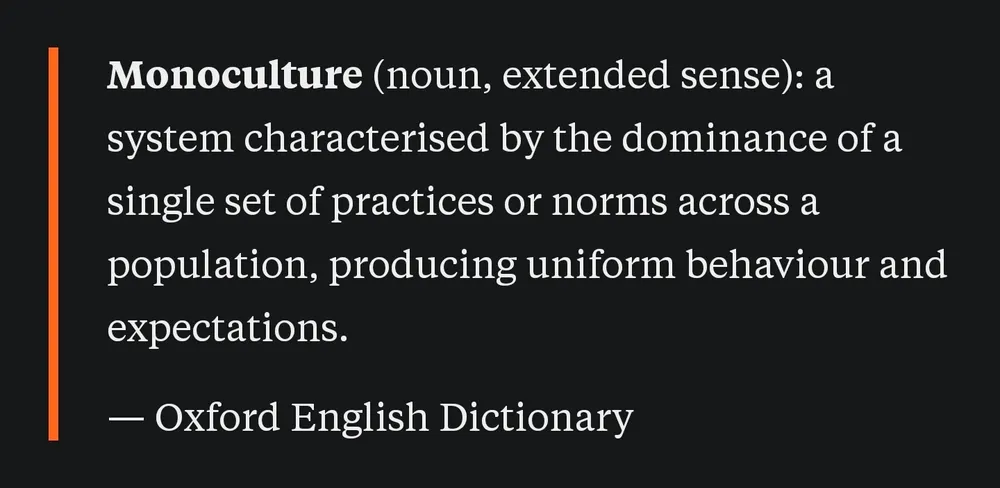
For liberalism to perpetuate, it is contingent on an underlying monoculture. Law cannot manufacture consent; its legitimacy is granted by a presupposed culture. When that culture is diminished, consent is withdrawn. Consensus becomes polarisation.
1
0
0
Applied at the civilisational level, a monoculture describes a society with a single overwhelmingly dominant culture. A monoculture does not imply cultural stagnation, aesthetic uniformity, or the absence of internal diversity. It describes dominance of behavioural norms and expectations.
1
0
0
Liberal democracy depends on a demos, and a demos depends on monoculture.
1
0
0